Best for visceral-fat tracking alongside broader body-composition trends: Hume Pod 2.0. Best for a foot-only routine with a dedicated index: Withings Body Smart. Best for a clearly labeled visceral-fat rating: OMRON BCM-500. This 2026 guide separates useful home tracking from claims a bathroom scale cannot support.
- Hume Pod 2.0 suits connected visceral-fat and body-composition tracking with no required subscription for core app tracking.
- Withings Body Smart suits readers who want a dedicated visceral-fat index in a foot-only scale.
- OMRON BCM-500 provides a visceral-fat rating with a hand-and-foot measurement routine.
- Home scales estimate visceral fat; they do not directly measure fat around individual organs or diagnose disease.
What a visceral-fat estimate tells you
Visceral fat sits around internal organs in your abdomen. It is different from the fat directly beneath your skin, and a change in body weight does not tell you exactly how either compartment changed.
A consumer body composition scale uses electrical measurements and an estimation model. A visceral-fat score is an estimate, not an image of your abdomen. Choose a scale for repeatable tracking and understandable results, not because its dashboard looks medical.
For your 2026 purchase, the useful question is simple: will this device help you notice a pattern and decide what to discuss or change next?
What makes the best scale for visceral fat?
- A specific visceral-fat output: Total body-fat percentage and a visceral-fat index answer different questions. Confirm that the exact model reports the metric you want.
- An understandable scale: A rating, index, percentage, and area measurement are not interchangeable. The app should explain its terminology.
- Repeatable measurements: Clear instructions about timing, foot contact, and measurement conditions make comparisons more useful.
- Readable history: You need to see change across repeated check-ins, not just celebrate or worry about the latest reading.
- Clear feature access: Separate included tracking from optional coaching, subscriptions, and other extras.
- Honest limits: A useful device explains what its estimates cannot tell you, including the difference between consumer tracking and medical assessment.
At a glance: body composition scales for 2026
The order below gives each scale a different job. It does not imply that one manufacturer's visceral-fat score is interchangeable with another's.
| Scale | Best for | Tracking approach |
|---|---|---|
| Hume Pod 2.0 | Visceral-fat and broader body-composition trends | Hand-and-foot sensors with companion app history and included core tracking |
| Withings Body Smart | A dedicated index with a foot-only routine | Visceral-fat index alongside body-composition estimates |
| OMRON BCM-500 | A clearly labeled visceral-fat rating | Visceral-fat level with a hand-and-foot measurement setup |
No home scale in this comparison earns a claim of diagnostic accuracy for visceral fat. Different electrode arrangements and more dashboard metrics do not, by themselves, prove better agreement with medical imaging.
1. Hume Pod 2.0: best for connecting body changes with habits
Hume Pod 2.0 is an at-home body-composition analyzer that includes visceral-fat tracking alongside body-fat, muscle, and body-water estimates. Its hand-and-foot sensors collect the measurements, and the companion app keeps your results together over time.
If you also use Hume Band 2.0, the app brings wearable and body-composition insights together. The Pod itself does not track sleep, activity, strain, or recovery.
Hume Pod 2.0 suits adults who want to follow visceral-fat estimates alongside broader body-composition trends, with no required subscription for core app tracking. Premium coaching and deeper personalized analysis are optional paid upgrades, not requirements for core tracking.
That makes Hume Pod 2.0 relevant if your buying question extends beyond a single fat score. For example, you can review body composition trends while reflecting on whether your sleep schedule or activity routine has changed. The relationship is context, not proof that one habit caused a particular reading.
Hume Pod 2.0 highlights
- At-home body composition tracking fits a recurring check-in routine.
- The companion app brings body composition and wearable insights together.
- Core app tracking does not require a subscription.
- Optional premium features remain separate from included core tracking.
Use the visceral-fat reading as a device-specific estimate. It cannot show how much fat surrounds an individual organ, and the Pod does not require a wearable to record body-composition trends.
Best for: Adults who want body composition context alongside everyday habit tracking.
If sleep and activity are your main questions, Hume Band 2.0 works on its own. Hume Pod 2.0 is optional; you do not need to buy both to start wearable tracking.
2. Withings Body Smart: best for a dedicated visceral-fat index
Withings Body Smart reports a visceral-fat index as part of its body composition tracking. That makes it a direct fit when you specifically want a home scale that names visceral fat rather than showing only weight and total body-fat percentage.
The index is useful as a device-specific tracking measure. It is not a literal percentage of your abdomen, and it should not be compared directly with another manufacturer's rating.
Withings Body Smart highlights
- Includes a specifically named visceral-fat index.
- Places that index alongside other body composition estimates.
- Uses a standing-on-the-scale routine without a separate hand unit.
The index is an indirect estimate, not an imaging result. Compare it with your previous Withings readings rather than converting it into another manufacturer's score.
Best for: Readers whose main requirement is a dedicated visceral-fat index within a home scale.
Withings Body Smart is a useful option if you prefer stepping onto a foot-only scale instead of holding a hand unit. Hume Pod 2.0 also includes visceral-fat tracking, so choose between them by the measurement routine and app experience you prefer, not an assumption that only one reports visceral fat.
3. OMRON BCM-500: best for a clearly labeled visceral-fat rating
OMRON BCM-500 reports a visceral-fat level and uses both hand and foot contacts during body composition measurement. You stand on the platform and hold the hand unit according to the device instructions.
This format suits someone who wants a defined check-in procedure and a clearly named rating. It also asks more of you than simply stepping onto a foot-only scale.
OMRON BCM-500 highlights
- Reports a specifically named visceral-fat level.
- Uses hand and foot contacts during measurement.
- Provides a structured measurement routine you can repeat.
Follow the instructions for holding the hand unit and positioning your feet. The visceral-fat level is an estimate, and its rating is not interchangeable with a Withings index or a Hume reading.
Best for: Readers comfortable with a hand-and-foot routine who want a clearly labeled visceral-fat rating.
Do not select OMRON BCM-500 solely because it has hand contacts. Electrode placement changes how a device collects information; it does not establish that its visceral-fat estimate is the most accurate for you.
How this ranking works
This 2026 comparison considers visceral-fat tracking, the measurement routine, and how each device fits a home record. Hume Pod 2.0 includes visceral-fat tracking within its broader body-composition view. Withings Body Smart offers a foot-only routine; OMRON BCM-500 provides a labeled level with hand and foot contacts.
These are feature-based comparisons, not results from a head-to-head accuracy test. No option is ranked as clinically more accurate than the others.
How to make your readings useful
Your routine matters more than reacting to every fluctuation. Bioelectrical impedance estimates respond to measurement conditions, including hydration; a changed reading does not automatically mean a matching change in body fat.
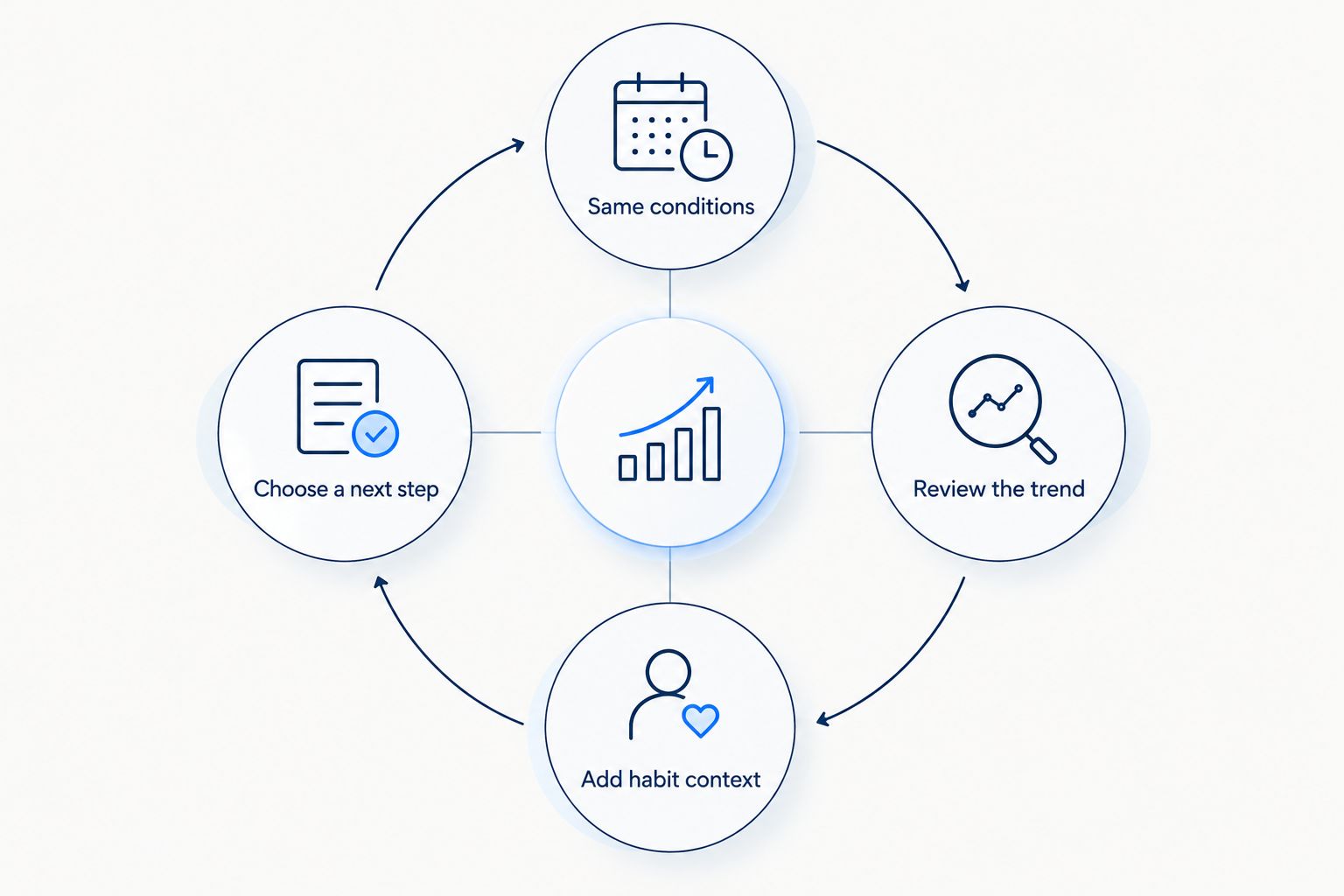
For a simple 2026 starting routine, plan 1 check-in per week for 4 weeks, unless your device instructions or clinician recommend otherwise. This is a manageable tracking schedule, not a validated threshold for detecting visceral-fat change.
Use the same conditions
Follow your scale's instructions and choose a repeatable time. Keep foot contact, clothing, and the scale's placement consistent rather than comparing readings taken under very different conditions.
Review the trend
Compare several check-ins before assigning meaning to a change. Do not treat an isolated rise as proof that a meal, missed workout, or poor night's sleep increased your visceral fat.
Add habit context
Record 2 short notes per check-in: one about your recent routine and one about anything unusual during measurement. These notes help you ask better questions without pretending the scale can identify cause and effect.
Choose a next step
Pick a practical action, such as keeping your usual bedtime more consistent or planning regular walks. If a result worries you, discuss the pattern with a clinician rather than trying to diagnose yourself from the app.
What a visceral-fat score cannot tell you
A scale cannot show the location of fat around individual organs. It also cannot diagnose diabetes, explain abdominal symptoms, or replace an assessment of your broader health.
Avoid comparing a manufacturer's index with an internet chart intended for another device. Even when the labels sound similar, the calculation and reference ranges can differ. Follow the interpretation supplied for your exact model.
Medical imaging, including CT and MRI, can assess internal fat distribution in ways a bathroom scale cannot. Whether that assessment is appropriate is a clinical decision, not a reason to request imaging just to check an app score.
Treat the scale as a tracking aid, not a health verdict. If you use an implanted electronic medical device, check the scale's safety instructions and ask your clinician before using its electrical body composition function.
Which scale should you choose in 2026?
Choose Hume Pod 2.0 if you want visceral-fat tracking alongside body-fat, muscle, and other body-composition trends in a connected app. Core tracking does not require a subscription.
Choose Withings Body Smart if you prefer a foot-only measurement routine with a dedicated visceral-fat index. Choose OMRON BCM-500 if you prefer its labeled visceral-fat level and hand-and-foot setup.
Do not buy a more complicated setup just to collect more metrics. The useful choice is the one whose output you understand and whose routine you will repeat.
FAQ
What's the best scale for visceral fat in 2026?
Hume Pod 2.0 suits connected visceral-fat and broader body-composition tracking. Withings Body Smart suits a foot-only routine with a dedicated index, while OMRON BCM-500 offers a labeled visceral-fat level using hand and foot contacts.
Can a smart scale actually measure visceral fat?
A smart scale estimates visceral fat rather than directly measuring fat around your organs. Its electrical measurements feed an estimation model, so the result is not equivalent to medical imaging.
Is visceral fat the same as body-fat percentage?
No. Body-fat percentage estimates the share of your body weight made up of fat, while visceral fat refers to fat around internal abdominal organs. One reading does not substitute for the other.
Does Hume Pod 2.0 have the visceral-fat measurement I need?
Hume Pod 2.0 includes visceral-fat tracking, as listed on its product page. Treat it as a body-composition estimate for following trends, not a direct measurement of fat around individual organs.
Do I need a subscription for Hume Health tracking?
Core Hume Health app tracking does not require a subscription. Premium coaching and deeper personalized analysis are optional paid upgrades.
Can I use Hume Band 2.0 without Hume Pod 2.0?
Yes. Hume Band 2.0 works on its own, and Hume Pod 2.0 is optional. Choose the wearable for wearable tracking rather than buying a scale you do not need.
Can I compare visceral-fat scores from different scales?
Do not treat different manufacturers' visceral-fat scores as interchangeable. Compare readings within the same device system and use the interpretation supplied for that model.
Should I worry if my visceral-fat score rises once?
One higher estimate does not establish that your visceral fat increased. Repeat measurements under consistent conditions and discuss persistent concerns with a clinician rather than diagnosing yourself from the score.
One last thing
Before your first check-in, write down what the visceral-fat output actually is: an index, a level, or another estimate. Save its explanation with your tracking notes.
That small step prevents a common comparison mistake: treating a device-specific score as a universal measurement. A number becomes useful when you understand what it represents and what it does not.